Garage Spray Foam Insulation
Flagstaff garages take the full brunt of a Zone 5B winter — spray foam on the walls, ceiling, and garage door area keeps the space usable and protects whatever's parked or stored inside it.
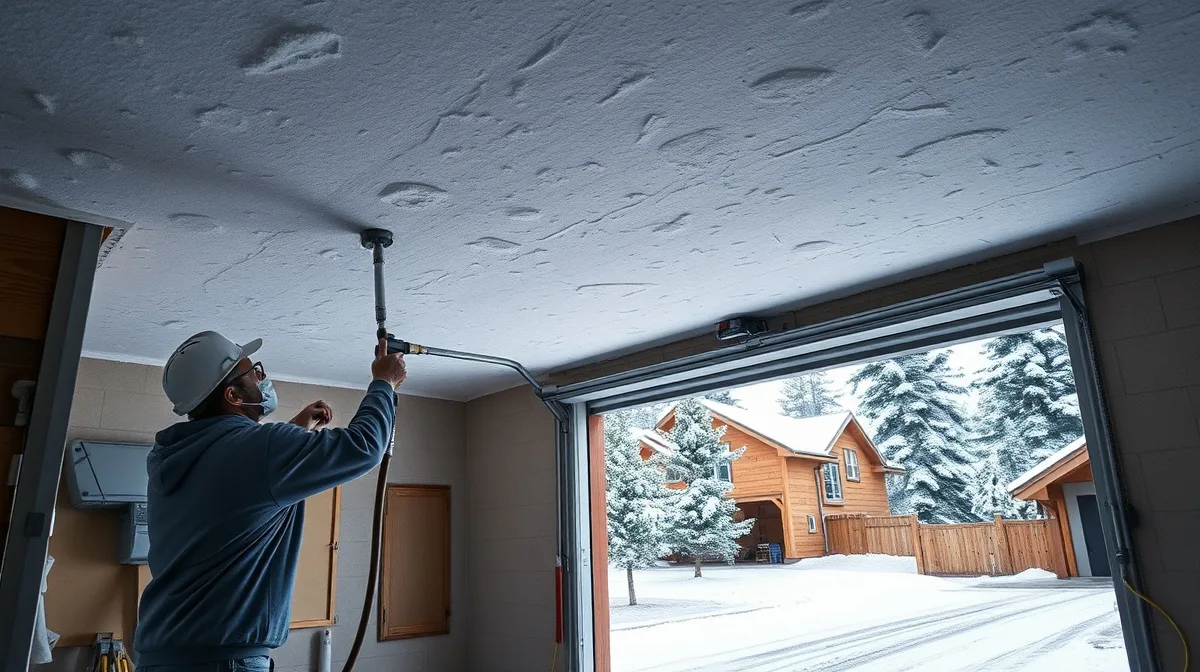
At nearly 7,000 feet, an uninsulated attached garage in Flagstaff doesn't just get chilly — it fully cold-soaks. Once outdoor temperatures sit in the teens and twenties for days at a stretch, an unsealed garage equalizes close to ambient, and that cold mass sits against whatever wall it shares with your living space. Homeowners feel it as a permanently cold spot in an adjacent bedroom or laundry room, a chilly floor overhead, or a battery that won't hold a charge through January. None of that is a furnace problem. It's an envelope problem, and it starts at the garage.
Spray foam insulation and air-sealing solve this the same way it solves an attic or a crawl space: by closing the gaps that fiberglass batts leave open around top plates, header framing, and the garage door perimeter, and by adding real R-value per inch instead of R-value on paper that settles or gaps out over a Flagstaff winter. For homes that use the garage as a cold-weather workshop, a place to keep a vehicle actually startable on a subzero morning, or overflow storage for anything that shouldn't freeze, closing off that cold-soak path is one of the highest-impact, lowest-disruption jobs we do. It's also one of the few insulation upgrades that pays off in daily convenience as much as in the utility bill.
Why homeowners choose it
- Keeps garage temperatures well above freezing so vehicles start reliably on cold Flagstaff mornings.
- Protects paint, tools, canned goods, and stored items from freeze-thaw damage over a long winter.
- Stops cold-soak transfer through the shared wall or ceiling into adjacent bedrooms, laundry rooms, or living space above.
- Air-seals framing gaps around the garage door header and man-door that fiberglass batts can't close.
- Makes an attached garage genuinely usable as a cold-weather workshop instead of a space you avoid from November through March.
- Reduces the heating load on the rest of the house by cutting off a major uncontrolled cold-air source.
Why Fiberglass Batts Fail in a Garage Application
Garages are one of the worst-performing spaces for batt insulation because the framing around them is full of irregular gaps that batts simply can't follow: the header over the garage door opening, the rough framing around a man-door, penetrations for electrical and garage door opener wiring, and the top plate where the wall meets the ceiling. Batts get compressed, cut short, or stuffed around these obstructions, and every one of those gaps becomes a direct path for outside air to move through the wall cavity. In a Flagstaff winter, that's a constant trickle of below-freezing air working its way into the assembly, which is exactly what keeps a garage cold-soaked no matter how much fiberglass R-value is technically installed.
Spray foam solves this by expanding to fill the cavity completely and adhering to irregular framing, sealing the header, the door and window rough openings, and the top-plate connection in the same pass as the main insulation work. That combination of insulation and air-sealing is why a foam-treated garage holds heat and blocks cold-soak in a way a batt-insulated one structurally cannot, regardless of the batts' rated R-value.
- Header framing over the garage door opening
- Rough openings around man-doors and windows
- Top-plate and ceiling transition points
- Electrical and garage-door-opener wiring penetrations
Walls, Ceiling, and the Shared Assembly with Living Space
Most garage insulation jobs in Flagstaff come down to two assemblies: the perimeter walls facing the outside, and the ceiling or shared wall where the garage meets conditioned space. Perimeter walls get treated similarly to any exterior wall assembly, closed-cell or open-cell foam sprayed into open stud bays to hit the R-20+5ci target used across the rest of the house. The bigger issue is usually the shared assembly — a garage-to-bedroom wall, or a garage ceiling with a bonus room or bedroom directly above it. That surface acts as the only thing standing between a cold-soaked garage and a room you're paying to heat, and it needs to perform like an exterior wall even though it's technically interior.
For garages with living space above, closed-cell foam on the ceiling framing gives both the R-value and the air-seal needed to stop that cold transfer, along with a moisture-resistant layer that handles any snowmelt or vehicle-related humidity tracked in from outside. We evaluate each garage's specific layout — where it sits relative to the house, what's directly above and beside it — before recommending open-cell, closed-cell, or a combination of the two.
- Perimeter garage walls insulated to R-20+5ci
- Shared wall or ceiling treated as a full thermal boundary, not an afterthought
- Closed-cell foam where moisture resistance and higher R-value per inch matter most
- Assessment of garage orientation and adjacency to living space before recommending a system
What to Expect from the Job
A typical garage foam job starts with a walkthrough of the space — wall framing, ceiling assembly, garage door type, and what's directly adjacent to or above the garage — followed by a straightforward install day. Garage jobs are generally faster and less disruptive than a full attic or crawl space project because the framing is usually exposed and accessible without demo work, especially in unfinished garages. Vehicles and stored items get cleared or covered, foam is sprayed into open cavities, and the space is left to cure before anything goes back in.
Because garages don't need to hit the same interior air-quality standards as a bedroom or living room, we have more flexibility in product choice, though we still follow standard cure-time and ventilation practices before the garage is back in daily use. Most jobs are completed in a single day for a typical two- or three-car attached garage.
Ideal for
- Attached garages sharing a wall or ceiling with conditioned living space
- Homeowners who use the garage as a workshop, gym, or hobby space through the winter
- Vehicles, especially ones with batteries or fluids sensitive to hard freezes overnight
- Garages used for storage of paint, chemicals, canned goods, or anything that can't freeze
- New construction or remodel projects where the garage ceiling doubles as the floor of a room above
What affects the cost
Garage Insulation questions, answered
Yes — garage insulation is one of our most requested services in the Flagstaff area specifically because attached garages cold-soak so hard through winter. We treat the walls, ceiling, and shared assemblies with living space to stop that cold transfer at the source.
In most cases, yes, especially when the garage door and header are properly sealed along with the walls and ceiling. It won't match a heated living space without a dedicated heat source, but a foam-sealed garage holds temperatures well above outdoor lows instead of equalizing with them.
An insulated garage door helps, but the bigger win is sealing the framing around the door opening and the header above it, since that's where most of the uncontrolled air movement happens. We'll flag whether your existing door is a weak point during the assessment.
Yes, this is one of the most common reasons homeowners call us. Foam on the garage ceiling framing stops cold-soak from transferring up into the room above, which fiberglass batts typically fail to do once gaps form around wiring and framing.
Most two- or three-car attached garages with accessible framing are completed in a single day, including cure time. Finished garages requiring drywall removal first will take longer.
Garage Insulation done right, by a local Flagstaff crew
Garage Insulation isn't a commodity — the result depends entirely on how carefully it's planned and installed for your specific home and Flagstaff's real high-country climate. We assess what your house actually needs, prep and air-seal properly, and install to your elevation-appropriate R-value target, so the work delivers the comfort and savings it's supposed to.
We serve Flagstaff, Munds Park, Williams, Kachina Village, Mountainaire, Doney Park, Fort Valley, Bellemont, Parks, and Sedona. Every job starts with a free, no-pressure quote.
Just as important, we treat your home like the system it is. Insulation, air sealing, and ventilation all interact, and getting one right while ignoring the others leaves comfort and savings on the table. When we scope your garage insulation, we look at how it fits the whole picture — so the finished result performs the way it should, holds up through a genuine Flagstaff winter, and actually lowers the bills you feel every month.
Free assessment
We evaluate your home and give you a clear, itemized quote.
Expert install
We prep, air seal, and install your garage insulation to spec — clean and on schedule.
Savings you can feel
A warmer home, lower heating bills, and honest advice about what your home needs.
Related services
Ready for a free garage insulation quote?
Tell us about your home and we'll put together a clear, no-pressure spray foam insulation quote — built for Flagstaff's real winters.